
AI Agent Memory Explained: Managing Shared Memory Across Teams and Organizations
I’ve often been fascinated by the concept of memory. This interest has only increased as I’ve gotten older. While gaining memories through experiences, I’ve forgotten more along the way, which creates a novel and interesting topic to ponder.
We forget for many reasons, but two concepts from academic research into memories stand out: retroactive interference (new information disrupts our ability to recall older information) and proactive interference(old information makes it harder to store new information). Both describe the mind as a vessel in which older memories crowd out the new, or new memories pile on top of old ones like the floor of a teenager’s bedroom, layer upon layer, burying what came before. This matters because how quickly we react to urgent situations depends in part on what we remember. Remembering everything is not always a virtue; everything remembered must be processed before we can act.
Memory has been top of mind because at Labviva we recently added deeper memory capabilities to our agentic applications, allowing our tools to persist user preferences and session context with much greater depth. The addition of this advanced memory allows for questions to be answered with more powerful context. One of our agentic focus areas is helping procurement and sourcing teams draft RFPs and RFQs to purchase complex scientific products and services. Memory is essential to support these flows, as nuances from previous conversations should be leveraged to create more effective and accurate RFPs and RFQs. For instance, knowing whether an RFP was successful, what protocols a company follows, and the history of procurement questions and compliance requirements will help ensure the impact and consistent improvement each generation cycle. All of this information can be learned and stored in memory during human-agent interactions.
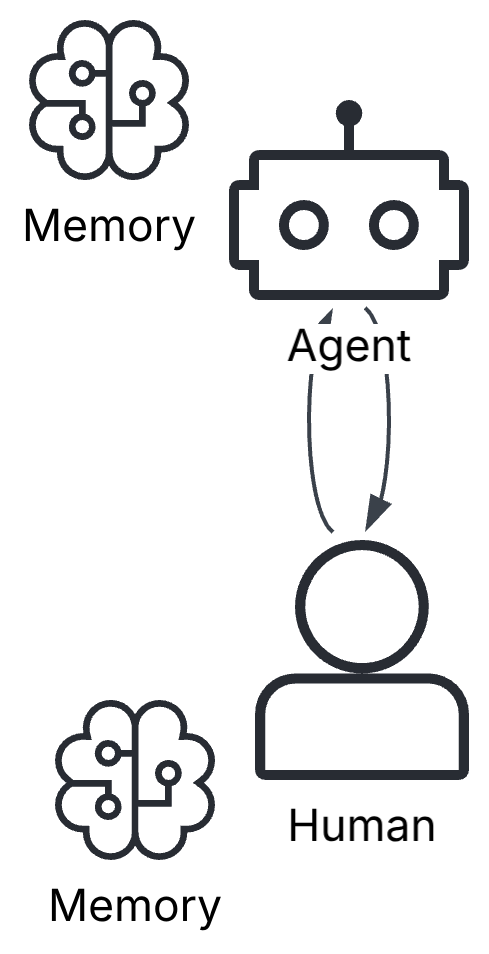
As an agent interacts with a human, it can build a memory of those interactions. If we imagine a single agent interfacing with a single human, we get a relationship like the following, where an agent has only a memory from the individual interactions, while the human has a memory of their own interactions with the agent and all of their other experiences outside of communicating with the agent. We could then consider the agent's memory to be a subset of the human's memory, aside from the fact that the agent and the human manage memory differently. The agent does not natively have the forces of proactive and retroactive interference (though these could be simulated through engineering), whereas human memory does. Also, human memory is constantly changing due to forces outside the agentic interaction.
This is not a real scenario, though. An agent is usually interacting with multiple humans and can build memory in multiple layers. The agent can have memory for each human it interacts with, but it can also have a shared memory of all its interactions with all the humans it interacts with. This is obviously very different from human memory and raises broader questions about how to make agents optimal at solving business problems.
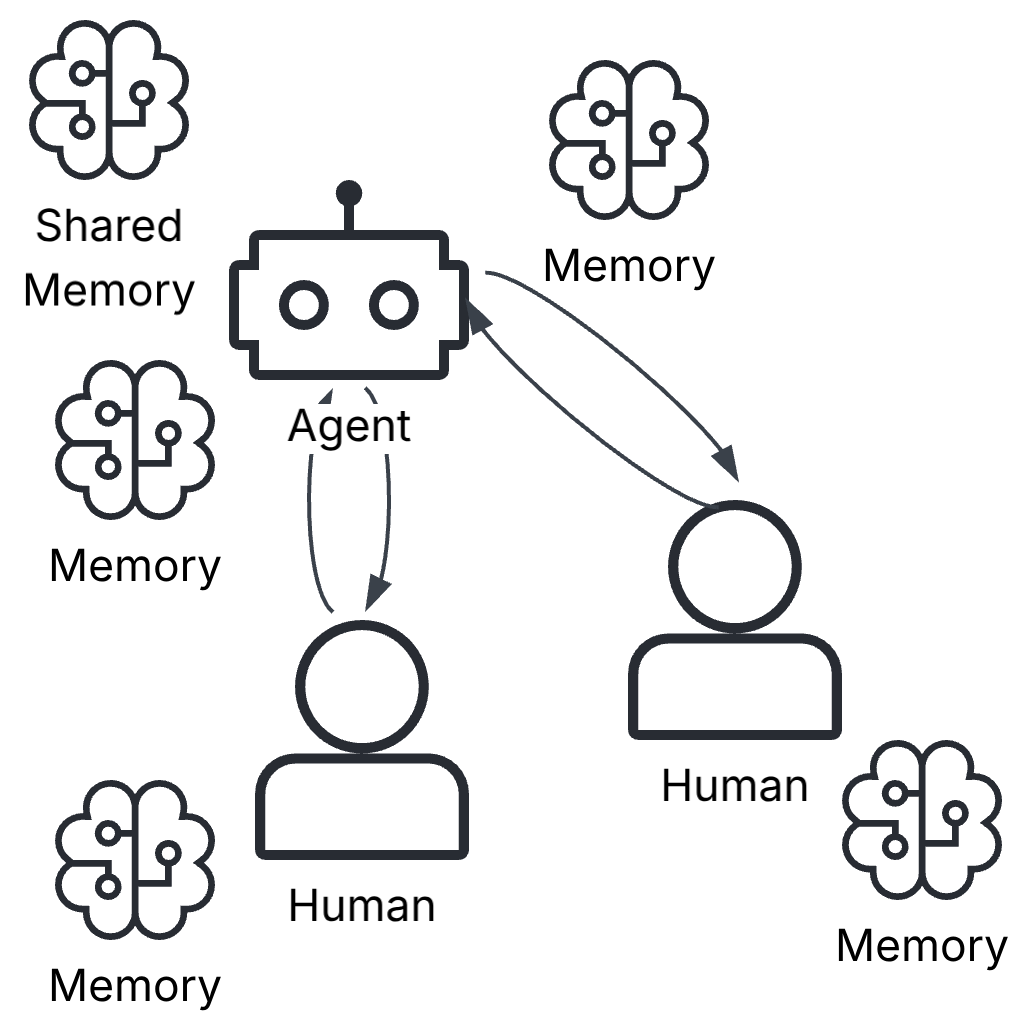
The first question that comes to mind is: “How is the shared memory managed, and can it be optimized?” Companies are formed from a variety of skill sets because tasks are complex and require multiple disciplines of experts to execute, and because different people and processes yield different outcomes when solving the same problem. Not every person and not every approach is optimal for the challenge at hand. If these forces are true, how can you elevate best practices within a shared memory model so that communal memory improves overall organization and all agent-human interactions?
Let’s say you work at a large company, and there are multiple teams creating RFPs and RFQs for different functions, but the tasks are basically the same: creating the documents, selecting suppliers, evaluating, and then selecting. Let’s also say that you work at a large company that, due to recent acquisitions, does not have a standard format for RFPs and RFQs across your enterprise. Since not every team at the company follows the same process and they are not the same people, we end up with the kind of fragmented, decentralized procurement workflows that make it hard to know which approach is actually working best. If each of these teams was communicating with an agent to assist their work and the agent is to learn from these teams how to execute, what should it execute to ensure an optimal outcome in the maximum number of cases across teams?
The solution that comes to my mind, which I feel is missing from much of the agentic conversation, is outcomes. Humans typically engage with agents to perform tasks, but very rarely is the agent informed of the outcome of those tasks. If we theoretically add in a step where after the human creates the RFP using the agent, they then feeds back to it all of the outcomes for each event (cost outcomes, performance outcomes, etc.), even months or years later, once impact can be determined, we can use that feedback loop to allow for the shared memory to prioritize what it retains and what it does not retain. Even if the agent is not using this feedback loop to purge memory, it can still use a ranking system to derive a selection hierarchy, determining which memories to prioritize going forward and simulating interference.
The second question that comes to mind is: do we have to wait until the agent learns actual outcomes to improve its performance at a task? The answer is “no”; if we know that some practices work better under certain conditions, we can present guidelines for agents using “evals” (Julia Winn has a great article on evals) and test and train against those evals, maintaining points of truth. Using approaches like these can help an organization embed its best practices in its agents and improve the performance of all humans interacting with the agent. This risks over-harmonizing processes, potentially causing all teams to perform the same way even when it is not optimal.
Organizations need to start thinking about their shared memories, the mechanisms that allow for the curation of that memory, and how agents will fundamentally change the understanding of best practices. Actively managing memory-what an agent listens to and learns from, and how we curate that memory will become the most important future tasks for agent-powered companies. Managers need to consider how they share their best practices through their agents and how those agents learn by establishing appropriate feedback loops.
As humans, we do not typically have the ability to consciously choose what we remember and how we remember those events. The forces of retroactive and proactive interference are natural processes that happen without our conscious awareness. In managing agentic memory, we have more control now and can have even more in the future. This provides us with an unprecedented opportunity to actually manage how our organizations remember concepts through managing the agents our teams work with. Through active management of organizational memory, we can use memory to write the story of our organizations. If we are the stories we tell ourselves, our agents are the outcomes of the stories we tell them.
Share:
Keep up with the latest on Labviva
Sign up to receive updates on the latest in life sciences, AI, and procurement from the Labviva team.

