
The Metabolism of Science: How Agentic AI is Transforming Academic Procurement

Executive Summary:
Academic institutions stand at a pivotal inflection point. The convergence of agentic AI, autonomous lab systems, and mounting geopolitical pressures - from tariff volatility to Scope 3 emissions mandates - is forcing a fundamental rethink of how research universities operate.
For decades, academic procurement has been defined by fragmented workflows, decentralized spending, and manual contracting. It has accumulated what we call "workflow debt." That era is ending. Distilled from Labviva's Academic Procurement Roundtable and Customer Advisory Board, this piece explores how agentic AI is transforming procurement from a bureaucratic bottleneck into the metabolic engine that keeps science moving
The Fragmentation Paradox: When Control and Autonomy Collide:
A perennial struggle in academic procurement is the tension between the “Academic Freedom” of the researcher and the “Institutional Stewardship” required by procurement and finance imperatives. Couple that with the fundamental upheavals in institutional funding mechanisms, and the historic “payment-first” culture - where institutions prioritized ease of payment over control of spend - is practically going away.
The “Skittles” Culture of Legacy Payments
Leaders at the roundtable noted that prior to digital transformation, many campuses suffered from extreme decentralization. One university leader described their previous environment as a “payment-first culture where we handed out credit cards like Skittles - everybody had one; you just had to have an ID and a pulse.” This approach led to a “click-through” mentality where researchers bypassed formal procurement channels to save time, resulting in massive “dark spend” trapped in unstructured PDFs and manual email chains.
By shifting to a managed marketplace platform, institutions have begun to see meaningful impacts across three dimensions:
- Cost Discipline: Institutions leveraging unified marketplace platforms have reported double-digit cost improvements by exposing researchers to competitive alternatives at point of purchase - shifting behavior without restricting choice.
- Work Hour Efficiency: Over 128,000 hours saved across academic users of managed marketplace platforms in 2025 by streamlining the “req-to-check” process and eliminating redundant manual touchpoints.
- Supplier Ecosystem Access: A shift from single-distributor reliance to a model where spend flows through a diverse, competitive network of over 150 unique suppliers - giving both institutions and their supplier partners broader reach and greater transactional efficiency.
Meeting Users “Where They Live”
The challenge for 2026 is ensuring that centralized platforms do not become bureaucratic hurdles that scientists seek to avoid. “The user experience has to be so intuitive and seamless that we’re driving to the goal without them even knowing that we’re asking them to do that,” noted one category manager. To achieve this, procurement must evolve into a “one stop shop” that handles both catalog and non-catalog pathways in a single pane of glass, allowing researchers to focus on science rather than administrative “workflow debt.”
Data from Labviva’s advisory board confirms that universities are already diversifying how they use the platform. Purchasing patterns vary significantly across institutions - some purchasing primarily through hosted catalogs, others relying on punchouts, and still others increasing their use of quote-based ordering for custom or high-value items. The most advanced institutions are now expanding beyond traditional lab supply categories into MRO, office supplies, software, and medical supplies, signaling a broader appetite for a single procurement layer.
From "Clicks" to "Instructions": Solving the Efficiency Drain:
The traditional procurement workflow is what roundtable participants called the "Click Apocalypse" - a sandwich of ERP systems, e-procurement platforms, and supplier punchouts that requires dozens of manual steps for a single purchase order. It is a system designed for a world that no longer exists.
The zero-friction vision emerging from our roundtables has three pillars. The first is Conversational Purchasing: a requester simply states, "I need a ¾-inch female pipe fitting," and an AI agent handles the rest. The second is Context-Aware Plugins: browser-based tools that validate price and compliance in real time without requiring the user to leave their workflow. The third is Unified Taxonomies: a single catalog spanning biological reagents, chemicals, and mechanical spare parts - eliminating the supplier fragmentation that drives shadow procurement.
The Multi-Agent Ensemble: A Factory of Specialized Intelligence:
The conversation has officially shifted from generative AI - which creates content - to agentic AI, which takes autonomous action. However, the consensus among procurement leaders at our roundtable was clear: the future does not belong to a single, all-knowing super agent. It belongs to an ensemble of specialized agents, each expert in its domain, working in concert.
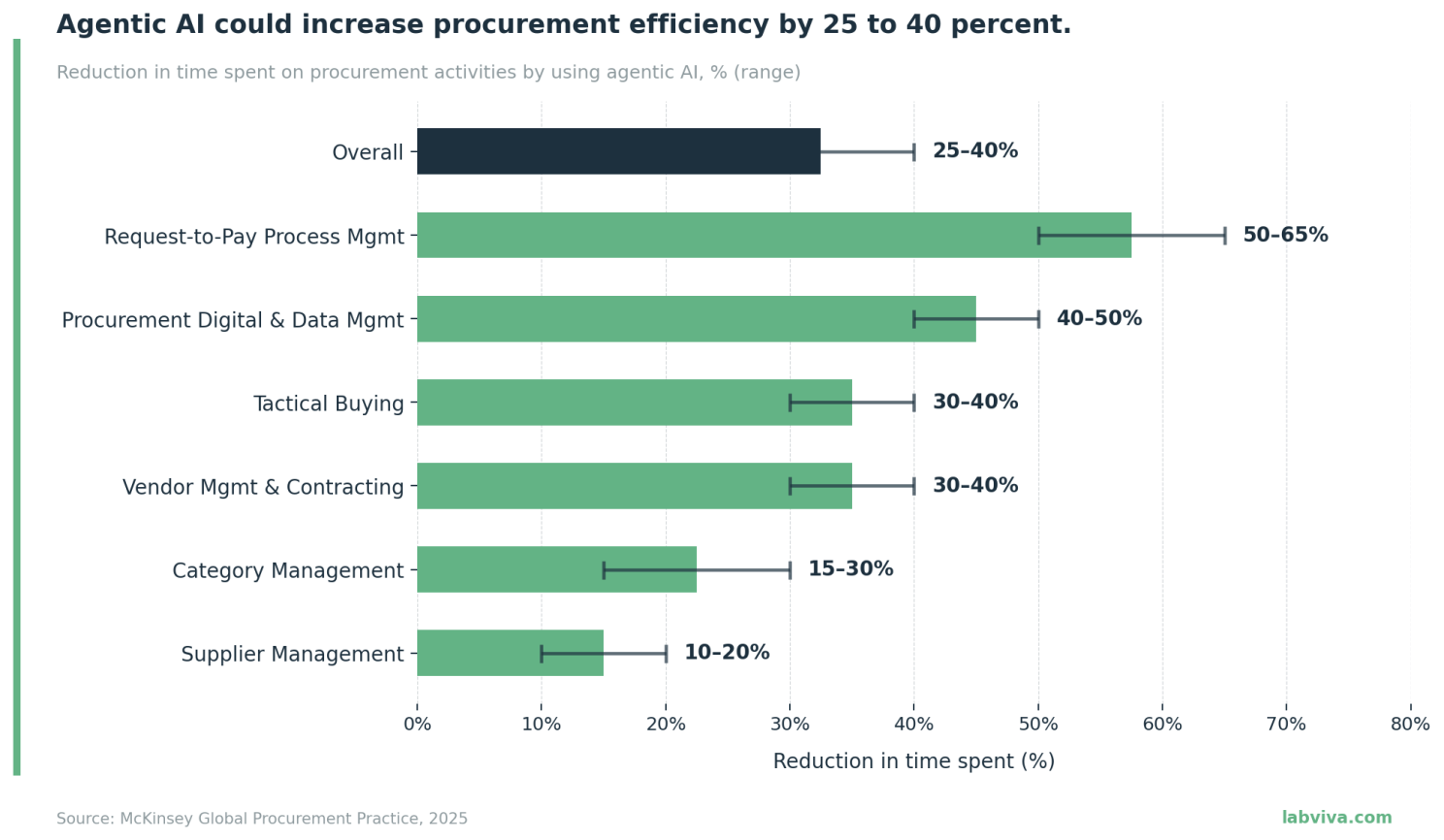
McKinsey & Company's research validates this approach with striking data. Agentic AI could increase overall procurement efficiency by 25% to 40%, with even more dramatic gains in specific functions: request-to-pay process management could see a 50–65% reduction in time spent, while procurement digital and data management could achieve 40–50% efficiency gains.[1]
Labviva's own "Factory of Agents" operationalizes this ensemble model across five specialized roles:
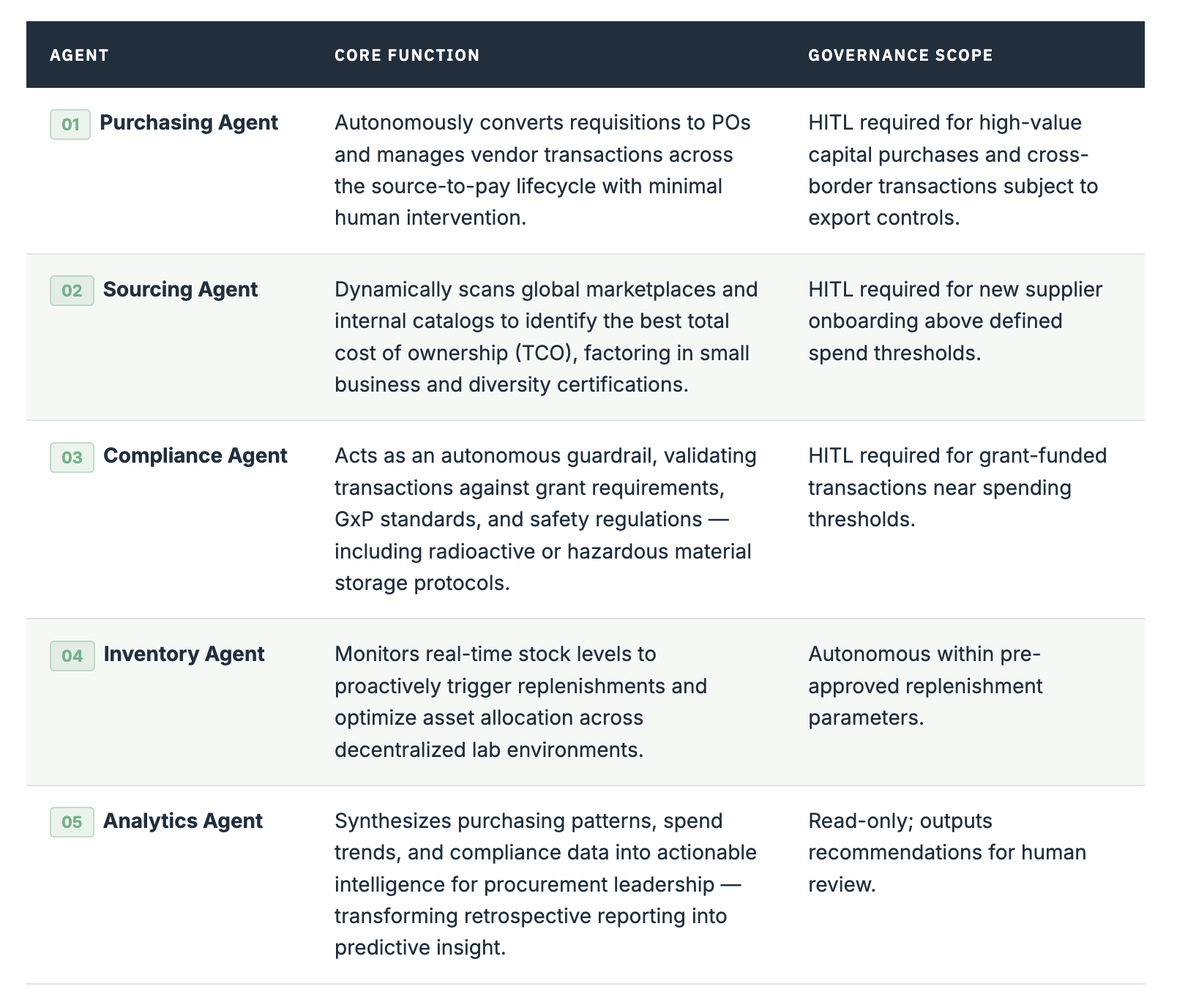
Critically, this model includes robust governance: auditable decision trails, configurable Human-in-the-Loop (HITL) intervention thresholds, and "blast radius" controls that limit the scope of any single autonomous action. Autonomy without accountability is not a solution, it is a liability.
The Intelligence Spine: Data as the New Institutional IP
"Software as a Service is getting commoditized. But the value part is your data and how it's tagged."
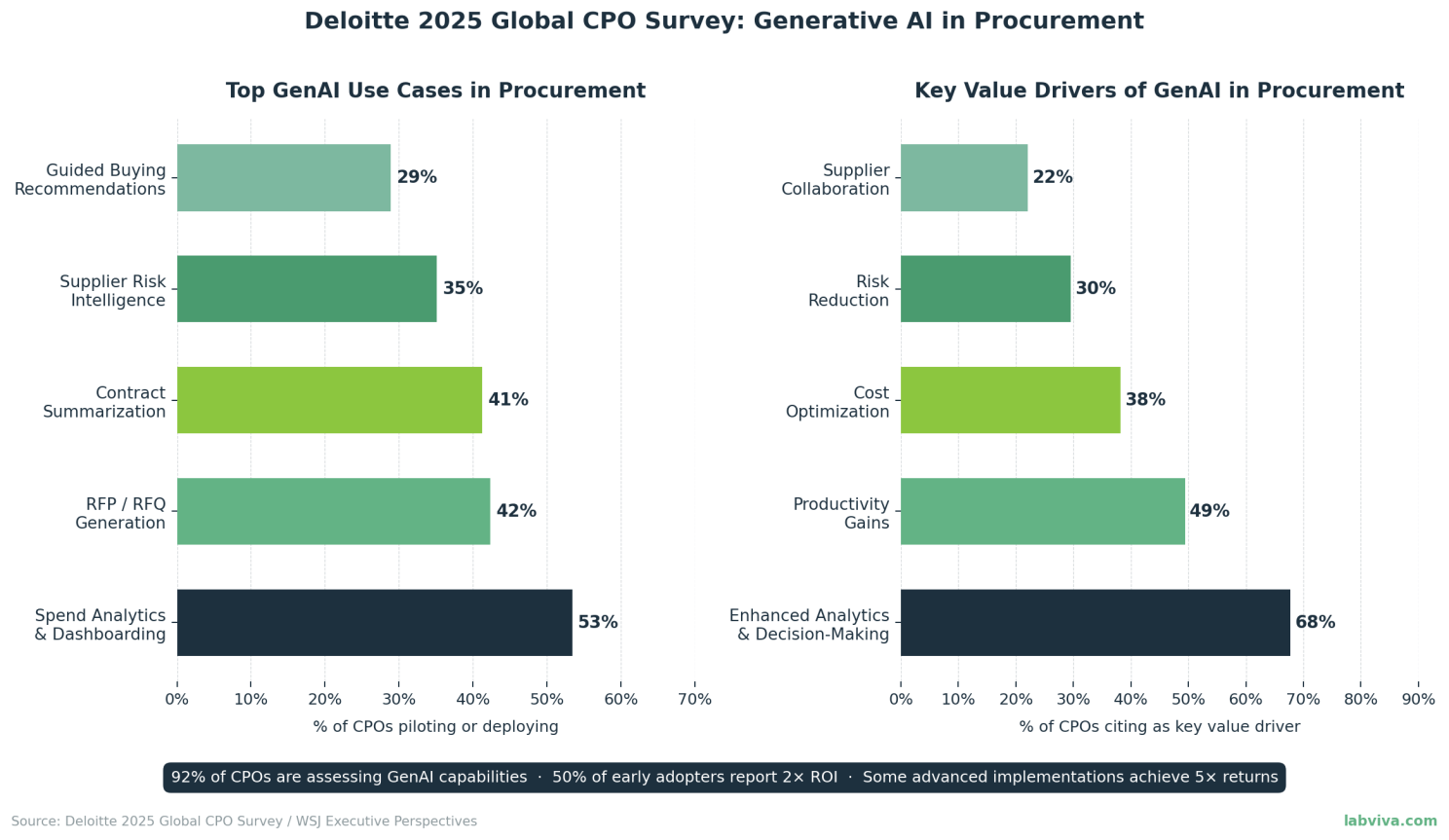
High-quality, well-structured data is the prerequisite for effective AI. Deloitte's 2025 Global Chief Procurement Officer Survey found that while 92% of CPOs are assessing Generative AI capabilities, the top three use cases - spend analytics (53%), RFP/RFQ generation (42%), and contract summarization (41%) - are all fundamentally dependent on clean, accessible data.[2] Among early adopters who have deployed AI in procurement, 50% reported a doubling of ROI compared to traditional methods, with some advanced implementations achieving 5× returns.
Solving the “One Man’s Pack Is Another Man’s Case” Problem
Unit of Measure (UOM) friction remains a major hurdle. Standardizing data across thousands of suppliers is difficult because no distributor can seem to agree on exactly what should constitute a pack or a case. By leveraging agentic processes to interrogate “price unit packaging quantity,” platforms are now achieving 99.7% precision in UOM harmonization, allowing for true “apples-to-apples” price comparisons.
Market-Informed Spend Intelligence
As the academic procurement ecosystem matures, institutions are looking beyond internal cost metrics to understand how their purchasing power compares with the broader market. The roundtable introduced the concept of community-informed pricing intelligence - an approach that aggregates anonymized transactional signals across the academic marketplace to provide institutions with a macro-level view of how pricing is evolving across key research categories.
This form of intelligence serves a strategic function: it enables CPOs to contextualize their own institutional spend within broader market dynamics, identify categories where pricing trends are shifting, and engage more informed conversations with their supply partners. Rather than a punitive benchmarking exercise, participants emphasized that this intelligence is most powerful when it fosters collaboration between institutions and suppliers - highlighting mutual opportunities to optimize pricing structures, consolidate volume, and improve contract terms in ways that benefit both sides of the transaction.
The aspiration is not to create adversarial leverage, but to build a shared understanding of market conditions that allows procurement teams and suppliers to align on value. When both parties are working from the same macro-economic context, negotiations become more productive and relationships become more durable.
AI-Assisted Purchasing and Contracting
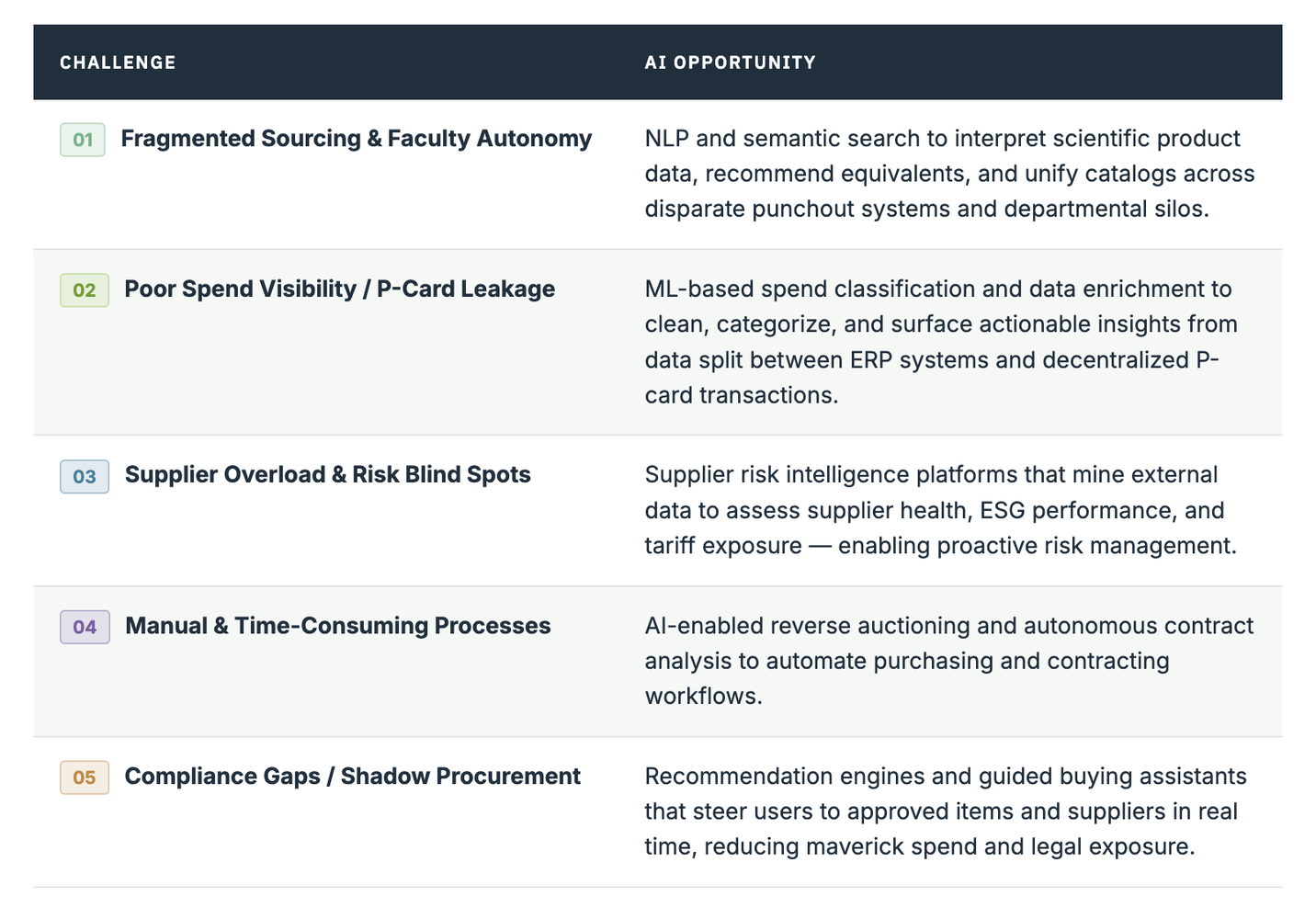
The roundtable dedicated significant attention to the pain points that procurement and contracting teams face daily - and the opportunity areas where AI can make the most immediate impact. Five persistent challenges emerged as consensus themes:
Autonomous Negotiation Intelligence
Guest speaker Nithin Mummaneni , CEO of Infinity Loop, highlighted that the “pre-negotiation” phase of contracting is ripe for automation. AI-native negotiation intelligence platforms can now analyze deal structures to surface risks, leverage points, and negotiation opportunities - reducing prep time for procurement teams by up to 80%. This doesn’t replace the human negotiator but upskills them, providing the macro insights and data-backed strategies needed to drive significantly improved deal outcomes.
The platform’s core capabilities - deal analysis, RFP supplier selection, consolidation analysis, category analysis, and vendor due diligence - are each tied to a specific negotiation outcome. Early adopters have reported 25–40x return on investment and 7–15% savings on total spend across contract and vendor negotiations, with savings locked in before contract signature.
Critically, this intelligence layer also addresses capacity constraints. By automating the analytical heavy lifting, procurement teams can handle more complex negotiations without adding headcount - a particular imperative in resource-constrained academic environments.
The Autonomous Lab and the “Speed to Science”
The final session of the roundtable focused on the “Lab of the Future,” where procurement becomes an invisible reflex of the scientific workflow.
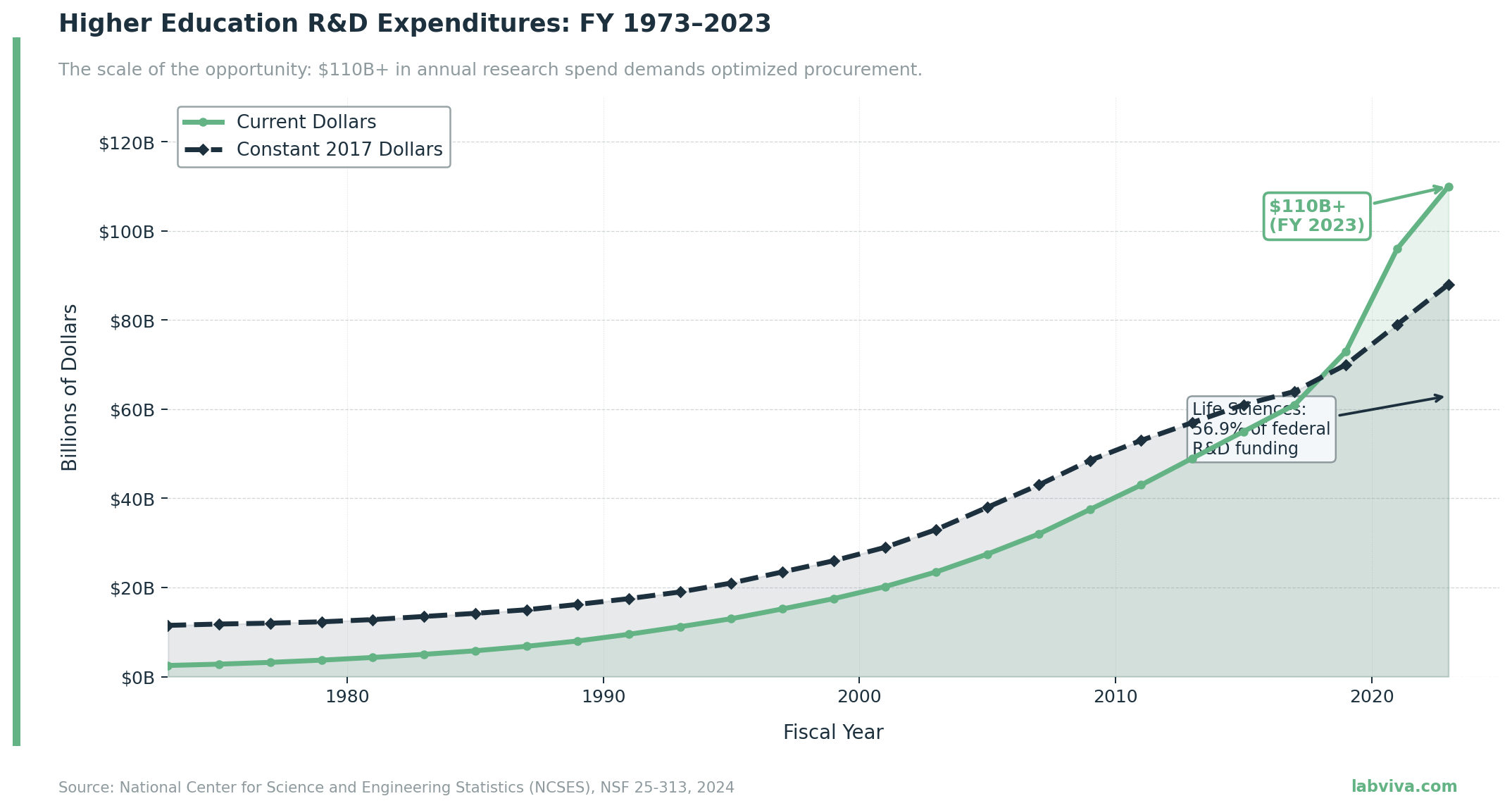
The ultimate goal of academic procurement is not just saving money. It is accelerating the "Speed to Science." The scale of the opportunity is enormous. Higher education R&D expenditures in the United States have grown from approximately $12 billion in 1973 to over $110 billion in current dollars in FY 2023 - with life sciences alone accounting for 56.9% of all federally financed higher education R&D.[3]
In the aspirational state, procurement is integrated directly into Electronic Lab Notebooks (ELN) and Lab Information Management Systems (LIMS). This creates a closed-loop ecosystem where scientific intent triggers operational action:
- Automated Demand Sensing: As a researcher designs an experiment within their ELN, the system autonomously identifies required reagents, consumables, chemicals, etc. to execute their study design.
- Intelligent Inventory Check: The AI cross-references the “Digital Twin” of institutional inventory - aware of stock levels across disparate locations - to prioritize existing assets before triggering new purchases.
- Predictive Procurement: If stock is insufficient, a purchasing agent executes a “just-in-time” order, validating against grant compliance and preferred pricing to ensure experimental continuity without human intervention.
Physical and Digital Convergence
This vision of autonomy extends beyond digital transactions into the physical lab environment. Merrit S. of Potato presented a framework for the autonomous lab, emphasizing the convergence of lab robotics with agentic intelligence. Their platform acts as a reinforcement learning environment for operating the wet lab - deploying AI scientists, world models, and lab robotics to close the loop from hypothesis to result.
Early benchmarks are striking: workflows that traditionally required two to three months of manual effort - literature review, protocol drafting, parameter identification, experiment design, and automation scripting - can be compressed to under two hours. This represents a 250x acceleration in time-to-lab for use cases like cell-based assay optimization.
While Labviva orchestrates the digital supply chain, Potato AI focuses on the interface of autonomous lab experimentation, where robotic workcells can be directed by the same agentic “brain” that handles procurement.
The convergence of these layers - supply chain orchestration, autonomous experimentation, and AI-powered negotiation - creates a compounding effect. Institutions that integrate across all three can simultaneously reduce the cost, friction, and cycle time of research execution
Conclusion: The Human-Agent Partnership
As institutions move toward an "Agent-First" model , the role of the procurement professional is not being eliminated - it is being elevated. The procurement leader of the future is not a manual operator processing requisitions. They are a strategic orchestrator, setting governance thresholds, interpreting market intelligence, building supplier partnerships, and ensuring that the agent ensemble operates in alignment with institutional values.
To prepare for this shift, leadership must prioritize:
- Master Data Integrity: Paying down “workflow debt” by cleaning and structuring master data now. The quality of agentic output is bounded by the quality of the data it acts on.
- Governance Frameworks: Building safety-first agent strategies that define exactly what an agent should not do - establishing clear HITL thresholds and auditable decision trails.
- Workforce Upskilling: Creating mentorship programs that teach staff how to review and validate AI-driven outputs, shifting the procurement competency model from transaction processing to analytical oversight.
- Supplier Partnership Models: Approaching market intelligence and pricing transparency as a collaborative tool - one that strengthens institutional-supplier relationships by grounding negotiations in shared data rather than positional bargaining.
- Sustainability Integration: Embedding emissions intelligence and tariff resilience into the procurement workflow now, before regulatory mandates force reactive compliance."We are managing a city here. Procurement is the metabolic process that keeps science moving."
“We are managing a city here,” noted one procurement executive. In that city, procurement is the metabolic process that keeps science moving. By embracing agentic orchestration, academic institutions can ensure that their “Speed to Science” is limited only by the imagination of their researchers, not the friction of their systems.
Authors:
Anisha M. Hammer, Ph.D. - Senior Director of Business Development at Labviva, where she advises academic institutions on procurement transformation and AI-driven supply chain strategy.
Nick Premnath - SVP of Commercial Strategy at Labviva, where he leads go-to-market efforts and shapes the company's strategic vision for AI-enabled procurement in research and life sciences.
The authors wish to thank the participants of Labviva's 2026 Academic Procurement Roundtable and Customer Advisory Board for their candid remarks and contributions to this work.
References
- McKinsey & Company. (2025). Transforming procurement functions for an AI-driven world. McKinsey Global Procurement Practice. mckinsey.com
- Deloitte. (2025). Generative AI in Procurement: CPO Survey. Deloitte Consulting / WSJ Executive Perspectives. deloitte.com
- National Center for Science and Engineering Statistics (NCSES). (2024). Higher Education Research and Development Survey, FY 2023. National Science Foundation. NSF 25-313. ncses.nsf.gov
- Mummaneni, N. (2026). Remarks at Labviva Academic Procurement Roundtable. Infinity Loop. Boston, MA.
- Savener, M. (2026). Remarks at Labviva Academic Procurement Roundtable. Potato AI. Boston, MA.
Share:
Keep up with the latest on Labviva
Sign up to receive updates on the latest in life sciences, AI, and procurement from the Labviva team.

